Wednesday, March 28, 2012

a short cut to...

...Mushrooms!...and all the local Hobbits are combing the woods for the brief annual appearance of Morels. It was probably this, that inspired me to make a mushroom-shaped stone bench.

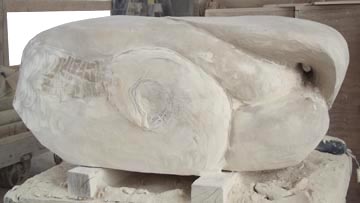
I began with this piece of scrap from a previous commission. I thought that this 1,000 lb. piece of stone would make a good mushroom cap.

I ground the top into shape, rigged it up and...

flipped it over to carve the gills with a tooth-shaped chisel.

I found this piece of stone to use for the stem. I cut the bottom flat with a grinder. Then, I drilled a series of holes to split off the extra stone, using 'feathers and wedges'.

I made sure that the 2 pieces fit together before doing the final carving.

This is the final results: it won't fry up in butter, but it will sit 2 to 3 people comfortably.

Other news...we went to the recently re-opened Otter Creek Park. Meg snapped this photo of fractal-like backwater eddies in the creek.

We found this old section of dry-laid stone wall that was probably from the time when the mill was in operation on the creek. There was also a town close by, called "Plain Dealing" (circa 1790-1850?), which is totally non-existant now.

We found this hoof-shaped formation of flowstone along the cliff that borders the creek.

Today, we found 3 baby possums on the road near the end of our driveway. They were still clinging to the body of their mother who had got hit by a car. We took them to Monica Wilcox of Woodland Wildlife Rehabilitators. They do an enormous task on a shoe-string budget. Please send these people a donation - they perform miracles and have totally given up their lives to help distressed wildlife. Their website is www.woodlandwildlife.org

This is 1 of 5 baby flying squirrels that were brought in by electric line workers. (Their mother had chosen a bad place to make her nest).

These are 2 of 8 Barred Owls that she is caring for. She has many other animals in her care. (all photos copyright 2012 Meg White)

Sunday, March 18, 2012

Everything Gone Green

This week has really seen a change in the seasons - it's spring!

I finally finished the sprout bench and made a base for it, too.

This functional sculpture is 45" long by 21" high by 18" deep, Indiana Limestone and weighs approximately 1,000 lbs.

Other news for this week is the completion of a 1/8 scale model for what I hope will be a new commission to be made in Indiana Limestone, 72" high by 37" wide by 27" deep. I am making a plaster cast of the plasticene model. Here, I have made a part-line shim in clear plastic and have sprayed everything with mold release.

I placed the model into a bucket. The part-line shim was custom cut for this particular plastic bucket. Then, I mixed molding plaster and poured it over the model.

The next morning, I removed the plaster mold from the bucket. I carefully separated the mold and removed the clay model.

I took the two halves outside and sprayed them with paint, which I hoped would help work as a release agent when it came time to pour in the plaster for the model. I also used the spray mold release, however, next time I might try a spray graphite. It didn't want to release very easily, and fought me every inch of the way.

I was worried about the plaster mold leaking when I tried to pour for the model. I used a ratchet strap to tighten it together and put it into a large container to catch any leaking plaster. Actually, I decided to make the model in Ultracal, which is a lot harder than molding plaster. It is also a different color; dark grey against the bright white of molding plaster. I'm very happy that I had the Ultracal, as I'm sure that it wouldn't have worked with just molding plaster.

After letting it harden overnight, I chiseled off the outer mold of plaster.

This is the Ultracal model. It has a few air bubble holes, but that won't affect its use as a working model.

Additional news at the studio - someone left these children on a bench near our outer gate. There is also a dragonfly ornament near their feet.

They also left these concrete mushrooms. A random act of kindness - How Cool!

Sunday, March 4, 2012

Sprout Bench, and Heavy Weather


This is a scale model in plasticene clay for a functional sculpture that I am currently making.

When I blocked out the previous bench commission, I had some large pieces of scrap that I intended to carve into other sculptures. This piece came out of the center of the first bench preform.

I moved the piece into the shop with the crane truck. Then, I cut the bottom flat, checking my progress with a level.

Next, I flipped the piece upright and began to rough in the shapes with an air hammer and large grinder.

I continued to refine the forms with a large grinder and a smaller 4" grinder.

I managed to get one of the holes clear through the piece. Not bad for a week's worth of work.

Friday, they were calling for 2-1/2" hail. We padded some of the finished sculptures and I moved the finished bench back inside.

We only got pea sized hail. You can see some of it in the lower portion of this picture. Two funnel clouds formed just to the north of us. They developed into an F3 and F4 tornadoes that wiped out Maryville, Indiana and killed at least 13 people.

Tuesday, February 28, 2012

The Grist Mill in Dubois Hollow

Meg and I had a great adventure on Sunday. We had permission to check out the remains of an old grist mill that is located in the woods fairly close to where we live. We are keeping the exact location secret, so that people don't bother the historic site ( and the land owners).

When you come upon the 3 story stone structure, it's a bit of a shock. It is made from dry laid sandstone blocks that were hewn and course-laid. This is the east wall. The original builder and owner was named Biddle. I have a great grandmother Biddle from this area, and I wonder if there is a connection. I was told that it took 7 to 9 years for him to build it. A team of oxen helped drag the stones and hoist them into place. They were young when it started and ready to retire when it was finished.

This is the west wall. We don't know when it was built, but guesses have it in the late 1700's or early 1800's.

This detail near the west wall shows where the water wheel rested. By looking at where the shaft went through the wall, I estimate that the wheel was about 20 feet high.

Inside the mill, resting against the south retaining wall, is this 'mystery stone'. It was hand drilled with a star drill and split. It has shaped ends to fit somewhere and 3 notches along the front. What was it's purpose? Someone went to a lot of trouble with it.

One of the coolest features is this box flue. I've never seen anything like it.

Meg took this shot from inside the mill where the flue rises up through the wall to the covered box flue.

Just uphill from the mill is the remains of a long, low stone and earthen dam.

It has filled in with dirt over the last 150 years. But, they would let it fill up, from water that came from a spring uphill and then open the gate to let it go down a wooden race to turn the mill wheel.

This is the remains of the spring house that is up the hill from the dam. This is a little cave spring, and it was running pretty good when we were there. The flow is never enough to turn a wheel. That's why they'd let it fill the pond and do the grinding in batches.

At the top of the hill is the chimney for the cabin where the owner lived.

Check out this diamond chisel pattern on the sandstone chimney stones.

These are steps for the ladies to dismount from carraiges. ( a touch of class, even in remote wilderness).

This marble tombstone, with these excellently carved hands, belongs to a man named Nathaniel Dubois, who was the last person to run the mill. He had a tavern in Louiville, and he was using the mill to make whiskey. After running off a barrel, he hired a young boy to help him move the barrel and hide it. The boy told a local Marshall, who knocked on the cabin door. When Dubois opened the door, he reached up for his hat, but the marshall thought he was reaching for a gun and shot him. He died February 24, 1868. His widow went back to Louisville after burying him here about 50 yards west of the cabin. The mill fell into disuse, and the story ends here.

Bench Finished

I've finished the functional sculpture in Indiana Limestone.

This is about where I left off last week. I polished the bottom and detailed the vine shapes. Then, I put the bench on 'spin cycle' and finished the other side, too.

Here are the final pictures of the finished piece, after moving it back outside and power washing it.

Another view as you walk around the piece...


I will live with it for a bit and probably find fussy litttle things to clean up. Then, I will spray on a breathable sealer to help keep air-borne grime off the sculpture. The last phase is delivery and installation.